Feature
The original pitches for this story were either to A) look at the Seamade program and the nutrition bars made on campus or B) look at the eels that have recently come to the Marine Science Center on campus. What follows are the varying drafts of the article.
Early Draft
American eels are now on campus
Students compete to enhance animal welfare
At the end of the fall semester, the University of New England acquired almost 1000 American eels for research at the Girard Marine Science Center.
The eels are not fully grown despite averaging a foot long each. American eels travel from where they are born in the ocean into rivers across the east coast of the United States. Like salmon, they are able to live in both freshwater and saltwater.
Dr. Gwangseok Rex Yoon is an assistant professor at UNE and is head of the Conservation Physiology and Aquaculture (CPA) Lab on campus. He has already started running into issues with the eels. “We’ve had lots of issues with skin abrasions,” Dr. Yoon said. “They rub on the bottom of the structure or even each other.”
Dr. Yoon, as well as GMSC vivarium manager Erin Ducharme, are trying to bring students on to help with this issue. The American Eel Habitat Enrichment Competition sees students working in groups to create prototype habitats that will be placed inside the tank with the eels. The winning group will see their prototype made into a fully operational structure in addition to a cash prize.
The majority of the entrants are a part of Dr. Carrie Byron’s Marine Ecology course and have entered for class credit instead of the cash prize.
Prototypes are scheduled to be judged by a panel of judges on February 26.
Developing Draft
New American eel research begins at UNE
Students compete to enhance animal welfare
In a dimly lit room inside the Girard Marine Science Center, a new species has found its home in one of the building’s many large tanks.
At the end of the last fall semester, the University of New England acquired almost 1000 American eels for research purposes at the Girard Marine Science Center.
Despite averaging a foot long, the eels are not fully grown yet. They are currently being kept in a 6 foot diameter tank on the MSC’s first floor. The room needs to be kept dark as the eels are nocturnal and quickly swim away from any light.
Dr. Gwangseok Rex Yoon is an assistant professor at UNE and is head of the Conservation Physiology and Aquaculture (CPA) Lab on campus. His lab will try to determine the effects of increasing temperature on the eels as a step towards making aquaculture systems more resilient to climate change.
American eels are actually an important fishery for Maine. Elvers – the name for baby eels – are often caught and sold to aquaculture companies in Asia where they are raised for food. Elvers have reached prices of over $2,000 per pound in the past, according to the Maine Department of Marine Resources.
American eels travel from where they are born in the ocean into rivers across the east coast of the United States. Like salmon, they are able to live in both freshwater and saltwater.
Dr. Yoon’s research is being funded as part of a larger research initiative at UNE in collaboration with the Gulf of Maine Research Institute. The initiative, called the UNE-GMRI Research Accelerator, has given nearly $40,000 dollars to four research projects led by faculty at both institutions.
Dr. Yoon has already started running into issues with the eels. “We’ve had lots of issues with skin abrasions,” Dr. Yoon said. “They rub on the bottom of the structure or even each other.”
Dr. Yoon, as well as GMSC vivarium manager Erin Ducharme, are trying to bring students on to help with this issue. The American Eel Habitat Enrichment Competition sees students working in groups to create prototype habitats that will be placed inside the tank with the eels. The winning group will see their prototype made into a fully operational structure in addition to a cash prize.
The majority of the entrants are a part of Dr. Carrie Byron’s Marine Ecology course and have entered for class credit instead of the cash prize.
Prototypes are scheduled to be judged by a panel of judges on February 26.
Workshop Draft
UNE lab fosters climate resilience in eels
Students are engaged in a fight against population declines
By Arianna Ochs
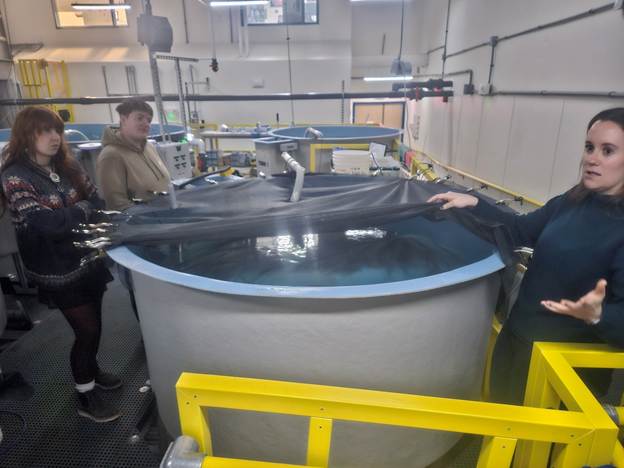
GMSC vivarium manager Erin Ducharme shows students the tank full of American eels.
In a dimly lit room inside the Girard Marine Science Center, a new species has found its home in one of the building’s many large tanks.
Last November, the University of New England acquired almost 1000 American eels for research purposes at the Girard Marine Science Center. “We’ve never had these animals before. Every species is different and needs different things,” said Erin Ducharme, the vivarium manager at the GMSC.
“It’s a new system we’re still learning about,” Ducharme said, speaking about the recirculating aquaculture system the eel tank is a part of. The eels are the first species to be placed into the new system. They are currently being kept in a 6 foot diameter tank on the MSC’s first floor. The room needs to be kept dark as the eels are nocturnal and quickly swim away from any light.
“It was a steep learning curve for everybody,” Dr. Gwangseok Rex Yoon, assistant professor at UNE and head of the Conservation Physiology and Aquaculture (CPA) Lab on campus, said. His lab will try to determine the effects of increasing temperature on the eels as a step towards making aquaculture systems more resilient to climate change.
“You can imagine this is a base camp for the eels before going out to the battlefield,” Dr. Yoon said.
Conservation aquaculture is different from conventional aquaculture practices. “We don’t grow them for human consumption. We grow them to stock the ocean,” Dr. Yoon said.
American eels are actually an important fishery for Maine. Elvers – the name for baby eels – are often caught and sold to aquaculture companies in Asia where they are raised for food. Elvers have reached prices of over $2,000 per pound in the past, according to the Maine Department of Marine Resources.
“Maine is the only state that allows an elver fishery across the entire country. This has led to a lot of caution around overfishing,” Dr. Yoon said. The Maine DMR has a cap on the amount of elver licenses in the state.
Despite this caution, climate change still threatens the industry. “The trend is clear: the population is declining,” Dr. Yoon said.
American eels travel from where they are born in the ocean into rivers across the east coast of the United States. Like salmon, they are able to live in both freshwater and saltwater.
“We have just begun to collaborate on this eel conservation project,” Dr Yoon said. The research is being funded as part of a larger research initiative at UNE in collaboration with the Gulf of Maine Research Institute. The initiative, called the UNE-GMRI Research Accelerator, has given nearly $40,000 dollars to four research projects led by faculty at both institutions.
The eels have already started to cause issues, including cannibalizing each other as a stress response. “They are not a gregarious species. They want to be alone,” Dr Yoon said.
“These animals are known for escaping. On the inflow pipe, there is this mesh over the hole. The eels, working together, pushed it out of the way so some of the small ones could get in,” Ducharme said.
Despite averaging a foot long, the eels are not fully grown yet. “They can fit into spaces about as small as a nickel,” Ducharme said.
Ducharme and Dr. Yoon are trying to bring students on to help with these issues. The American Eel Habitat Enrichment Competition sees students working in groups to create prototype habitats that will be placed inside the tank with the eels.
“I was always looking for ways to get students involved,” Ducharme said. “I think we have 39 students officially signed on to the competition.”
“When a problem comes up, it’s generally not straightforward. Fish are weird. They do weird things, and it’s always something unexpected,” Ducharme said.
The winning group will see their prototype made into a fully operational structure in addition to a cash prize.
The majority of the entrants are a part of Dr. Carrie Byron’s Marine Ecology course and have entered for class credit instead of the cash prize. “The faculty and staff at UNE are fantastic. When a student comes up and says that they want to do a project, the response is always ‘How can we make this happen?’” Ducharme said.
Dr. Yoon hopes that the eels can continue to foster student involvement. “This could be an education hub for everyone, regardless of major,” he said.
Revised Draft
New fish species sets up camp in UNE lab
Students come to a new species’ aid in the fight against population declines
By Arianna Ochs
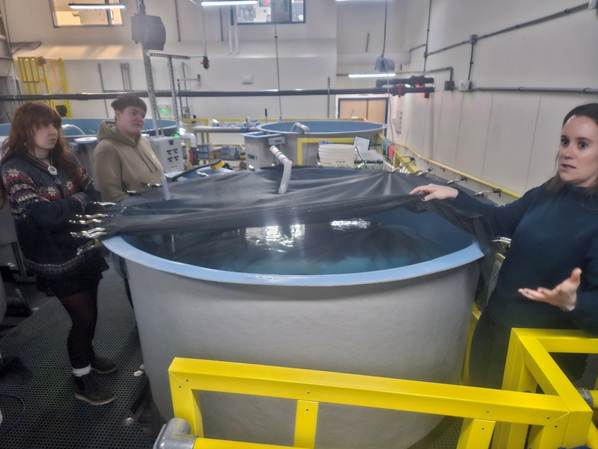
GMSC vivarium manager Erin Ducharme shows students the tank full of American eels.
In a dimly lit room inside the Girard Marine Science Center, a new species has found its home in one of the building’s many large tanks.
Last November, the University of New England acquired almost 1000 American eels for research purposes at the Girard Marine Science Center. “We’ve never had these animals before. Every species is different and needs different things,” said Erin Ducharme, the vivarium manager at the GMSC.
“It’s a new system we’re still learning about,” she said, speaking about the recirculating aquaculture system the eel tank is a part of. The eels are the first species to be placed into the new system. They are currently being kept in a 6 foot diameter tank on the MSC’s first floor. The room needs to be kept dark as the eels are nocturnal and quickly swim away from any light.
“It was a steep learning curve for everybody,” Dr. Gwangseok Rex Yoon said. Dr. Yoon is an assistant professor at UNE and head of the Conservation Physiology and Aquaculture (CPA) Lab on campus. His lab will try to determine the effects of increasing temperature on the eels as a step towards making aquaculture systems more resilient to climate change.
“You can imagine this is a base camp for the eels before going out to the battlefield,” Dr. Yoon said.
Conservation aquaculture is different from conventional aquaculture practices. “We don’t grow them for human consumption. We grow them to stock the ocean,” Dr. Yoon said.
American eels are actually an important fishery for Maine. Elvers – the name for baby eels – are often caught and sold to aquaculture companies in Asia where they are raised for food. Elvers have reached prices of over $2,000 per pound in the past, according to the Maine Department of Marine Resources.
Maine is the only state in the country that allows for the commercial fishing of elvers which has led to an abundance of caution. The Maine DMR has a cap on the amount of elver licenses in the state.
“The trend is clear: the population is declining,” Dr. Yoon said. Despite the caution of lawmakers, climate change has hurt eel populations.
American eels travel from where they are born in the ocean into rivers across the east coast of the United States. Like salmon, they are able to live in both freshwater and saltwater. The hope for the lab is to release the eels once they have become fully grown to bolster stocks.
“We have just begun to collaborate on this eel conservation project,” Dr Yoon said. The research is being funded as part of a larger research initiative at UNE in collaboration with the Gulf of Maine Research Institute. The initiative, called the UNE-GMRI Research Accelerator, has given nearly $40,000 dollars to four research projects led by faculty at both institutions.
The eels have already started to cause issues, including cannibalizing each other as a stress response. “They are not a gregarious species. They want to be alone,” Dr Yoon said.
“These animals are known for escaping. On the inflow pipe, there is this mesh over the hole. The eels, working together, pushed it out of the way so some of the small ones could get in,” Ducharme said.
Despite averaging a foot long, the eels are not fully grown yet. Though they may be long, the eels are quite thin with the smallest being able to fit in spaces the size of a nickel.
Ducharme and Dr. Yoon are trying to bring students on to help with these issues. The American Eel Habitat Enrichment Competition sees students working in groups to create prototype habitats that will be placed inside the tank with the eels.
“I was always looking for ways to get students involved,” Ducharme said. “I think we have 39 students officially signed on to the competition.”
The winning group will see their prototype made into a fully operational structure in addition to an unspecified cash prize.
The majority of the entrants are a part of Dr. Carrie Byron’s Marine Ecology course and have entered for class credit instead of the cash prize. “The faculty and staff at UNE are fantastic. When a student comes up and says that they want to do a project, the response is always ‘How can we make this happen?’” Ducharme said.
Dr. Yoon hopes that the work done here can have a real impact on not just the eels, but on the students as well. “Everyone can be a part of our conservation journey, regardless of major.
Workshop Reflection
The workshop helped me to smooth the story out. There were some parts of my article that I hadn’t noticed when writing that others pointed out to me. For example, the consistent rhythm and pace with which I was utilizing the quotes was something I didn’t realize was there until people pointed it out in the workshop. Next steps would be to look at the feedback I got and incorporate it. While I wasn’t able to find the time to interview someone from the contest, I definitely will be taking a fine-tooth comb to the quotes I have to try to find a better ending. I also need to go back and ask myself if certain segments would be better served as a quote versus summary.
Project Reflection
I think the place where this project really pushed me was on the time scale part of things. I needed to push myself and get more pro-active regarding the interviews. I am really glad that I was able to get them both in before the first deadline. Having the check in drafts along the way rather than writing the whole thing at once was also greatly appreciated. The initial drafts were barren without my interviews, and that forced me to look for other information I could use to bolster my story. That’s when I found the information from the Department of Marine Resources which really brings the article together. I think being forced to write at a consistent pace rather than in one sitting made for a better article. The workshop is also the space where I found a lot of help in refining the story. I have tendencies when writing that I overlook while editing my own work, and having others point them out to me forces me to re-evaluate the article in a way I would not have otherwise. If there was any sort of “a-ha” moment, it would have to be my interview with Dr. Yoon. The core of the story is the question of why the eels were here to begin with. Prior to the interview with him, I had no clue what the answer to it was. I had asked Erin Ducharme about it, and she did not have a complete picture of the lab’s purpose because she’s just meant to make sure the animals don’t die. Having Dr. Yoon’s interview in hand let me actually write the article beyond background information on eels that is not specific to the story I was covering. In all, this whole process served to lit a fire under my seat so to speak and put a spotlight on the cracks in my writing so I could cover them up. I am still unsure of how to come up with a good headline, though.
